

Posted on

How to Become a Registered Tax Agent in Australia (2026)

Last updated: 29 September 2026
Wondering how to become a registered tax agent in Australia? The path depends on your qualifications and experience and understanding it early can save you time and money.
Whether you’re an accountant or bookkeeper ready to expand your services, a career changer, a school leaver, or someone looking for a flexible new direction later in life, this guide explains the Tax Practitioners Board (TPB) pathways, the study you’ll need, and how to complete it online at your own pace with NBIA.

The short answer

To become a registered tax agent, you generally need to:

(1) hold a qualification or experience that fits one of the TPB’s six pathways;
(2) complete TPB-approved study in Australian taxation law and commercial law, where your pathway requires it; (3) meet the relevant-experience requirement; and
(4) satisfy the TPB that you are a fit and proper person and can hold professional indemnity insurance. Registration is decided by the TPB.

What does a registered tax agent do?

A registered tax agent can provide tax agent services for a fee or other reward. This can include helping clients understand and meet their tax obligations, preparing tax returns, providing taxation advice and representing clients in dealings with the Australian Taxation Office (ATO). Registration is administered by the Tax Practitioners Board.

Is becoming a tax agent right for you?

Tax agent registration suits a range of people:

  • Accountants, bookkeepers and finance professionals who want to offer clients more services and move into better positions.
  • Career changers who want a structured, in-demand skill set. You’ll usually start with foundation accounting study and build up (see “Starting from scratch?” below).
  • School leavers looking for a clear pathway into accounting and taxation.
  • Mature-age learners and people approaching retirement who want flexible, self-paced study and the option to work independently.

The main thing to plan for is experience. The TPB assesses relevant experience in tax agent services, so registration is a journey rather than a single course.

What qualifications do you need to become a tax agent?

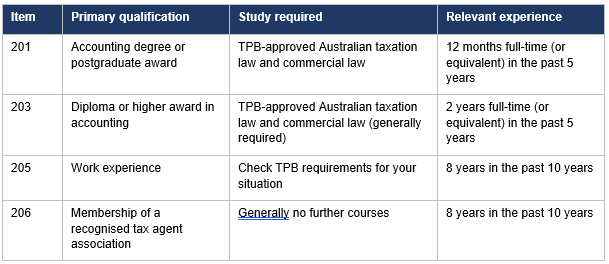
There isn’t one single pathway that applies to everyone. The TPB outlines six main pathways under Items 201–206 of the Tax Agent Services Regulations 2022. Your existing qualifications, previous study and work experience all affect what you still need to complete before applying. A summary of four of the main pathways:

TPB table

Items 202 and 204 cover relevant degrees outside accounting and law degrees. See the TPB’s qualifications and experience page for the full details of each pathway.

This is why it’s important not to assume another person’s tax agent pathway will be the same as yours.

Australian taxation law study

For many TPB pathways, applicants must have completed Board-approved Australian taxation law study. These courses cover important areas of Australian tax law and include assessment requirements designed to show you’ve developed the required knowledge and skills.

The TPB also requires Australian taxation law study to include the Tax Agent Services Act 2009 and the Code of Professional Conduct, unless you’ve completed this content separately.

Commercial law study

Commercial law is another key component for many prospective tax agents. Rather than one narrow area of law, the TPB expects approved commercial law study to cover areas such as Australian legal systems, contracts, business structures, entities and property law. Depending on your pathway, this may be study you still need to complete before applying.

Can you study tax law online? What about supervised assessment?

Yes, you can study online, but the way a course is assessed matters as much as the content. The TPB states that at least 40% of the assessment for an approved Australian taxation law course should be completed under independent supervision. Remote or online supervision may be used where the assessment is live-invigilated and meets the TPB’s integrity requirements.

This means choosing a course is not simply a matter of finding tax law content online. Check that the course is TPB-approved and that supervised assessment is built in.

How much experience do you need?

It depends on the registration pathway you use. The TPB assesses experience in tax agent services and taxation law, rather than simply counting any accounting employment. Current requirements include:

  • Accounting degree or postgraduate pathway (Item 201): generally, 12 months’ full-time relevant experience, or equivalent, within the previous five years.
  • Diploma or higher accounting pathway (Item 203): generally, two years’ full-time relevant experience, or equivalent, within the previous five years.
  • Work experience pathway (Item 205): eight years’ relevant experience within the previous 10 years.

Are there other requirements to register as a tax agent?

Yes. As well as meeting the study and experience requirements, applicants must satisfy the TPB that they are a fit and proper person, be at least 18 years old, and hold (or be able to maintain) professional indemnity insurance that meets TPB requirements. Registered tax agents also have ongoing obligations, such as continuing professional education.

Already have an accounting qualification?

Before enrolling in more study, check what you’ve already covered. You may already have some of the required education through:

  • an accounting degree
  • a Diploma or higher accounting qualification
  • previous taxation law subjects
  • previous commercial law subjects
  • other recognised tertiary study.

Instead of automatically enrolling in an entire qualification, identify the specific education gap between what you hold and the TPB pathway you plan to use. The TPB also provides a Qualifications Check tool that lets you test whether previous or proposed study may meet its educational requirements. NBIA also offers Recognition of Prior Learning (RPL) for people with relevant work experience and skills.

Starting from scratch? A typical study pathway

If you’re new to accounting, you don’t need to do everything at once. A common progression looks like this:

  1. Build foundation skills with the Certificate IV in Accounting and Bookkeeping.
  2. Work towards BAS agent registration with the BAS Agent Registration Skill Set, a practical way to start offering services to small businesses.
  3. Step up to the Diploma of Accounting or Advanced Diploma of Accounting.
  4. Complete the Tax Agent Certification to cover TPB-approved tax law and commercial law.
  5. Build your relevant experience, then apply to the TPB.

Your own route may be shorter or different depending on prior study, so a course advisor can help map it out.

A practical checklist

  1. Identify your existing accounting or tertiary qualification.
  2. Review your academic transcript.
  3. Determine which TPB registration pathway may apply to you.
  4. Check whether your previous study covers the required taxation law and commercial law subjects.
  5. Identify any study gaps.
  6. Consider whether you meet, or are building towards, the relevant-experience requirement.
  7. Complete any outstanding study before applying to the TPB.

Study tax agent education online with NBIA

The National Business Institute of Australia (NBIA) is a Melbourne-based Registered Training Organisation (RTO #21476) with over 20 years’ industry experience. Our Tax Agent Certification (FNSSS00005 Commercial Law for Tax Agents and FNSSS00008 Tax Law for Tax Agents) is designed to help you meet the TPB’s education requirements for Commercial Law and Australian Tax Law, when combined with a completed Diploma of Accounting (or higher) and the relevant experience requirements.

What you get when you study with NBIA:

  • Online, self-paced learning: 12 months’ access to the course and learning portal to complete the five units of competency or finish sooner.
  • Real industry support: experienced trainers and assessors with industry backgrounds, plus a Student Support Team (Monday–Friday, 9am–6pm), help requests chat and drop-in and meet-and-greet virtual sessions.
  • Practical learning: assessments that include practical case studies, projects and role-plays based on real-work scenarios, plus e-learning guides, templates and webinars.
  • Built-in supervised assessment: online supervised sessions to help you meet the TPB’s 40% requirement.
  • A student community: 24/7 access to the student portal and a Facebook discussion group.
  • Free membership of the Institute of Public Accountants (IPA) for students included with the course.

The Tax Agent Certification is priced at $1,995. If you already hold accounting qualifications, you may not need to start from the beginning, and our team can help you understand the options based on the study you’ve already completed. See our student support services to learn more about how we help you along the way.

Ready to explore your pathway?

Speak with an NBIA Course Advisor and have your previous study or academic transcript handy, so we can help you work out the pathway that may be relevant to you.

Speak to a Course Advisor | Download the course brochure

Phone (03) 9584 0900 | Email info@nbia.edu.au

Frequently asked questions

Do I need a degree to become a registered tax agent in Australia?

No. The Tax Practitioners Board (TPB) offers six pathways under Items 201–206 of the Tax Agent Services Regulations 2022. Some are based on an accounting degree, some on a Diploma or higher qualification in accounting, and others on work experience or membership of a recognised professional association. Each pathway has different study and experience requirements, so check which one fits your circumstances.

Can I complete the tax law and commercial law study online?

Yes, provided the course is approved by the TPB and assessed in line with its requirements. The TPB requires at least 40% of the assessment for an approved Australian taxation law course to be completed under independent supervision, and online supervision can be used where the assessment is live invigilated. NBIA’s Tax Agent Certification is delivered online, with online supervised assessment sessions to help you meet this requirement.

How long does it take to become a registered tax agent?

It depends on your existing qualifications and how much relevant experience you already have. Study and experience are separate requirements. NBIA students have 12 months’ access to complete the five units in the Tax Agent Certification and can finish sooner. The experience requirement can take longer than the study, so it is worth planning both together.

What is the difference between a BAS agent and a tax agent?

Both are registered with the TPB. A BAS agent provides BAS services, such as GST and business activity statement work. A registered tax agent can generally provide a broader range of tax agent services, including preparing tax returns, giving taxation advice and representing clients in dealings with the ATO. Many people start with BAS agent registration and work towards tax agent registration later.

Are there other requirements besides study and experience?

Yes. Applicants must also satisfy the TPB that they are a fit and proper person, be at least 18 years old, and hold (or be able to maintain) professional indemnity insurance that meets TPB requirements. Registered tax agents also have ongoing obligations, such as continuing professional education. Always confirm current requirements directly with the TPB.

Can I work for myself as a registered tax agent?

Registered tax agents may work within an accounting practice or run their own practice, subject to meeting TPB requirements. Running a practice also means planning for insurance, compliance and ongoing professional development, so it’s worth speaking with a course advisor and the TPB before you commit.

NBIA provides education and general course information. Registration as a tax agent is determined by the Tax Practitioners Board, and applicants should confirm their individual eligibility and requirements directly with the TPB.