
Posted on
Claim It Right: How Continuing Education Can Boost Your Tax Return
For many Australians, investing in education is about more than gaining a qualification—it is about creating better career opportunities, increasing earning potential, and staying competitive in a rapidly changing workforce.
For many Australians, investing in education is about more than gaining a qualification—it is about creating better career opportunities, increasing earning potential, and staying competitive in a rapidly changing workforce.
What many students and prospective leads do not realise is that continuing your education can also provide valuable financial relief at tax time. If your studies directly connect to your current employment or income-producing activities, you may be eligible for significant tax benefits.
Whether you are currently studying or looking to upskill in Accounting, Bookkeeping, Payroll, Taxation, Conveyancing, or Business Administration, understanding self-education deductions can help you maximise the value of your learning investment with the National Business Institute of Australia (NBIA).
Why Continuing Education Matters More Than Ever
Australia’s professional landscape is evolving at breakneck speed. Driven by automation, digital cloud accounting systems, AI tools, and tightening regulatory frameworks, employers are actively looking for practical, job-ready professionals who take initiative.
This is especially true right now. With the landmark Anti-Money Laundering and Counter-Terrorism Financing (AML/CTF) reforms officially expanding on 1 July 2026 to cover accountants, bookkeepers, and conveyancers, compliance awareness is no longer optional—it is a core industry demand.
Upskilling with an NBIA course helps you:
Maintain Industry Relevance: Stay ahead of major legislative updates and compliance changes.
Boost Confidence & Knowledge: Speak authoritatively on complex tax, BAS, and payroll structures.
Increase Earning Potential: Position yourself for that upcoming promotion or salary review.
Can You Claim Your NBIA Course on Tax?
In many circumstances, yes.
According to the Australian Taxation Office (ATO) guidelines, self-education expenses are deductible if the study meets one of two main criteria:
It maintains or improves the specific skills or knowledge required in your current employment role.
It results in, or is likely to result in, an increase in income from your current employment activities.
Who Can Claim? (Real-World Examples)
The Accountant upskilling to the Tax Agent Certification to become licensed with the Tax Practitioner Board (TPB) and extend their business practice services.
The Bookkeeper undertaking advanced accounting or BAS services qualifications to expand their firm's client offerings.
The Conveyancing Assistant completing formal conveyancing qualifications to step up into a senior, licensed role.
The Small Business Owner studying Business finance to run their operations more profitably.
The Golden Rule: The ATO assesses claims based on a direct connection to your current income-earning activities. Courses undertaken purely to switch to an entirely different industry generally do not qualify.
What Can (and Cannot) You Claim?
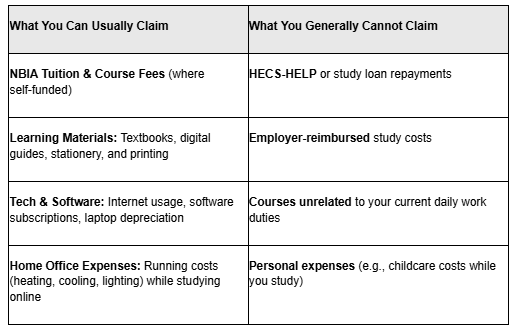
To help you navigate tax season smoothly, here is a quick breakdown of what the ATO typically allows and what it rules out:
Meet Sarah: An NBIA Student Success Scenario
Imagine Sarah, who works full-time in payroll administration. To step into a higher-paying team leader role, she enrols in an online bookkeeping and BAS course with NBIA. Because her studies directly relate to her current field and can demonstrably lead to a salary increase, Sarah can potentially deduct her course fees, her dedicated study internet percentage, and her textbooks on her next tax return.
The Secret to a Smooth Tax Time: Record Keeping
The number one reason legitimate education deductions are knocked back by the ATO is poor documentation.
The ATO expects taxpayers to keep clear evidence of their expenses. To make tax time completely stress-free, start a digital folder today and compile your Quick Self-Education Tax Checklist:
[ ] Your official NBIA Course Invoices and payment receipts
[ ] Receipts for textbooks, software, or stationery supplies
[ ] A log of your internet and home office hours dedicated to your study
[ ] Receipts for any tech hardware (like a new laptop) used for your course, so you can calculate depreciation
Current NBIA Students: You can easily access and download your official course invoices directly through your student portal ahead of June 30!
Study Smarter, Grow Faster
Flexible online learning has made it easier than ever for busy working professionals, parents returning to work, and regional learners to upskill without putting their careers on hold.
However, because the ATO utilises increasingly advanced data-matching technology to review work-related deductions, accuracy is key. Ensure you claim honestly, keep your receipts, and always seek guidance from a registered tax professional to tailor these rules to your unique financial situation.
Frequently Asked Questions
Can online courses be tax deductible? Yes. As long as the online course directly relates to your current employment and meets the ATO’s criteria, the delivery method does not affect its deductibility.
Can I claim a new laptop bought for my studies? Potentially. If it is used for eligible work-related self-education, you may be able to claim a deduction for its decline in value (depreciation). If it is used for both work/study and personal use, you must apportion the claim accurately.
If I want to completely change careers, can I claim the course? Usually no. If the course is designed to open up a brand-new career path entirely unrelated to your current job, the ATO generally deems it non-deductible.
Need Expert Help This Tax Season?
Navigating the fine print of self-education deductions can still feel overwhelming, and ensuring your claims are perfectly aligned with ATO guidelines is vital for peace of mind.
If you want to ensure you are maximising your refund safely and setting up a smart financial strategy, look no further than our trusted network partners:
For Individuals & Small Businesses: Reach out to the team atTax Store Australia. With locations nationwide, their qualified accountants specialise in tailored, smart financial solutions to unlock opportunities unique to your study and work situation.
For Established Businesses, Entrepreneurs & Corporate Tax: Connect withASV Wadeson Accountants. As a top-tier firm, their expert advisors provide high-level tax strategy, advisory, and financial management to help you scale and secure your financial future.
Take the Next Step with NBIA
Investing in a qualification is a powerful way to secure your financial and professional future. By studying strategically, you can upgrade your skills, step up into new career roles and potentially enjoy a more rewarding tax season.
Looking to upskill? Don't wait for the new financial year. [Download an NBIA Course Guide Today] to find the perfect qualification to align with your career goals and enhance your professional value.
Are you a current student? Log into your NBIA student portal to ensure your documentation and invoices are ready for your accountant this tax time.
Disclaimer: This article contains general information only and does not constitute financial or taxation advice. Individual circumstances vary. Readers should seek professional advice from a registered tax agent regarding their personal situation.
References & Further Reading
Australian Taxation Office (ATO): Self-Education Expenses Eligibility and Claims Guide
Australian Taxation Office (ATO): Tax Time Toolkit: Self-Education Expenses PDF
AUSTRAC: AML/CTF Tranche 2 Reform Milestones and Transitional Rules
Department of Home Affairs: Overview of the Anti-Money Laundering and Counter-Terrorism Financing Amendment