

Posted on
From Courtroom to Conveyancing: Why Australian Legal Professionals Are Making the Switch
For many lawyers, solicitors, paralegals and legal secretaries, there comes a point where traditional legal practice no longer aligns with the lifestyle they want.

Long hours. Relentless deadlines. High emotional and professional pressure.
If this sounds familiar, you’re not alone.
Across Australia, a growing number of legal professionals are choosing conveyancing as a second career in law — not by leaving the profession entirely, but by reshaping how they work within it.
Rather than stepping away from legal work, they are making a strategic move into licensed conveyancing, a role that offers flexibility, autonomy and continued engagement with legal frameworks — without courtrooms, litigation stress or billable hour burnout.
Conveyancing in Australia: A High-Demand Legal Career
Conveyancing is a recognised and regulated profession in Australia, with consistent demand across all states and territories.
With ongoing property transactions, population growth, and the widespread adoption of electronic settlement platforms such as PEXA, qualified conveyancers are increasingly sought after.
Job platforms such as SEEK and Indeed regularly advertise roles including:
* Licensed conveyancer
* Conveyancing clerk or assistant
* Property law paralegal
* Settlements and compliance officer
Industry bodies and employers have also reported skills shortages in conveyancing, particularly among professionals with a legal background.
Why Conveyancing Appeals to Lawyers and Legal Support Staff
Conveyancing sits at the intersection of law, property and client advisory work, making it a natural transition for many legal professionals.
Compared to traditional legal roles, conveyancing offers:
* Predictable workflows and timelines
* Control over workload (including part-time, remote or contract-based work)
* No court appearances or adversarial litigation
* Opportunities to specialise in residential, commercial or off-the-plan matters
* The ability to build or join an independent practice
You continue using your legal expertise — without the lifestyle strain.
Transferring Your Legal Skills to Conveyancing
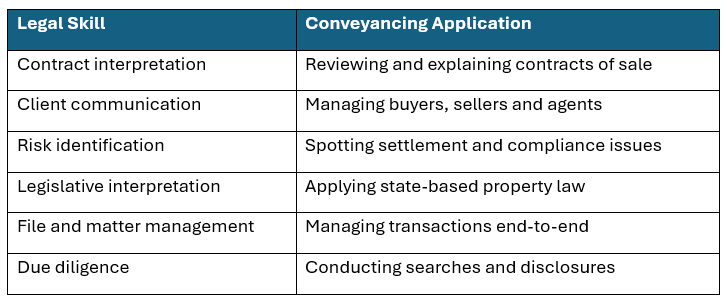
One of the strongest advantages of switching into conveyancing is that you are not starting over. Legal professionals already possess the core competencies required to succeed in conveyancing practice.
How to Become a Licensed Conveyancer in Australia
To obtain a conveyancer’s licence, you must complete the nationally recognised: Advanced Diploma of Conveyancing (BSB60220)
This qualification is required for licensing across Australia, with state-specific regulatory requirements applying in jurisdictions such as Victoria, NSW, Tasmania and Western Australia.
The Advanced Diploma of Conveyancing covers:
* Property law
* Contract law and risk management
* Trust accounting
* Professional ethics and compliance
* Settlement processes, documentation and systems
* Business operations for running a conveyancing practice
Learn more at https://nbia.edu.au/courses/ad...
A Career Side Step — Not a Step Back
For most legal professionals, conveyancing is not about abandoning their career.
It is about redesigning it.
Former lawyers who move into conveyancing often say: “I still use my legal training — I just control my time now.”
Conveyancing becomes a second chapter in a legal career, not an exit strategy.
Is Conveyancing the Right Career Move for You?
You are well suited to conveyancing if you:
- Have legal training or experience
- Enjoy structured, process-driven work
- Want flexibility and control over your workload
- Value professional independence
- Want to remain active in law without burnout
A Smarter Way to Stay in Law
Conveyancing is not a downgrade from law. It is a strategic redesign of how legal professionals work.
Many who make the transition say: “It’s the legal career I wish I’d discovered earlier.”
It’s not retirement.
It’s law — designed for life.
Ready to explore your next career chapter?
Learn more about the Advanced Diploma of Conveyancing (BSB60220) and licensing pathways at: 👉 https://nbia.edu.au/courses/ad...