
Posted on
Conveyancer vs Solicitor in Australia: Key Differences
Compare conveyancer vs solicitor careers in Australia. Learn about qualifications, licensing, salary differences and which pathway suits you.

What Is the Difference Between a Conveyancer and a Solicitor?
The main difference between a conveyancer and a solicitor in Australia is the scope of legal authority and qualification pathway.
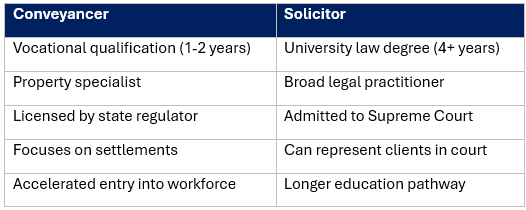
A conveyancer is a property specialist who focuses specifically on the legal transfer of real estate ownership. They are qualified through vocational education and are licensed (in licensing states) to manage property transactions and settlements.
A solicitor is a fully qualified legal practitioner who has completed a university law degree and practical legal training. Solicitors can work across multiple areas of law including property law, and may represent clients in court or provide broader legal advice.
In short, conveyancers specialise in property transactions, while solicitors have wider legal authority and training across the legal system.
Conveyancer vs Solicitor
If you’re considering a career in property law, or researching who to engage when buying or selling property, you may be wondering about the difference between a conveyancer and a solicitor in Australia.
While both professionals deal in property transactions, they follow different education pathways, have different scopes of legal authority and can also earn different salary ranges. Understanding the distinction is important if you are deciding:
✔ which career pathway suits you
✔ how long you want to study
✔ whether you need a law degree; or
✔ what earning potential to expect
This guide explains how conveyancers and solicitors differ in qualification requirements, daily responsibilities, licensing and career progression within the Australian legal and property system.
What Does a Conveyancer Do?
A conveyancer is a property specialist who manages the legal transfer of real estate ownership. They focus specifically on property transactions and settlement processes. Typical responsibilities include:
✔ Reviewing and explaining contracts of sale
✔ Conducting title and property searches
✔ Preparing transfer documents
✔ Liaising with banks and real estate agents
✔ Calculating settlement adjustments
✔ Managing electronic settlements (e.g., PEXA)
✔ Lodging documents with the Titles Office
Conveyancers specialise in property law processes. Their work is structured, deadline-driven and highly procedural. In many states (such as Victoria, SA and NSW), licensed conveyancers can operate their own conveyancing practice.
What Does a Solicitor Do?
A solicitor is a qualified legal practitioner who has completed a university law degree and practical legal training and is admitted to practice law. Solicitors can work across many areas of law including:
✔ Family law
✔ Criminal law
✔ Wills and estates
✔ Commercial law
✔ Litigation
✔ Property law
Some solicitors also perform conveyancing work, but property transactions are only one part of their broader legal practice. Solicitors can represent clients in court, provide legal opinions and handle disputes, responsibilities that extend beyond conveyancing.
Key Differences at a Glance

Education Pathway Comparison
Conveyancer Pathway:
✔ Advanced Diploma of Conveyancing (AQF Level 6)
✔ Practical industry experience
✔ State-based licensing (in licensing states)
✔ Study duration is typically shorter than a law degree and focuses on applied, workplace-based skills.
Solicitor Pathway:
✔ Bachelor of Laws (LLB or JD)
✔ Practical Legal Training (PLT)
✔ Admission to legal practice
✔ This pathway usually requires 4–6+ years of higher education before practising independently.
Salary Comparison: Conveyancer vs Solicitor
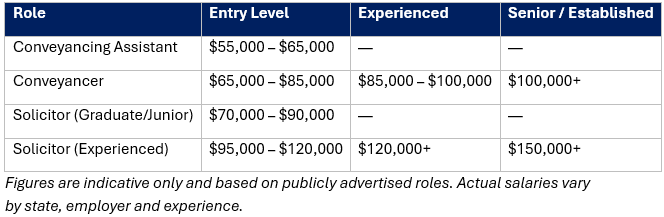
Salary is often part of the decision-making process. While earnings vary depending on location, experience and firm size, the following ranges reflect typical advertised salaries in Australia (2026).
Indicative Salary Ranges
How to Interpret This
Solicitors often earn higher salaries at senior levels. However, it is important to consider:
✔ The longer study commitment required to become a solicitor
✔ University tuition costs
✔ The time before entering the workforce
✔ The broader legal responsibilities involved
Conveyancers can enter the workforce sooner and specialise in property transactions without completing a law degree. For many students, the decision is not just about salary, it is about lifestyle, study commitment and preferred type of work.
Which Professional Does a Property Buyer Need?
For standard residential property transactions, many buyers and sellers engage a conveyancer. A solicitor may be more appropriate where:
✔ A legal dispute arises
✔ Complex legal advice is required
✔ Litigation or court representation is involved
In summary:
Conveyancers manage the property transaction process. Solicitors provide broader legal representation.
Which Career Is Right for You?
Conveyancing may suit you if you:
✔ Prefer structured, process-driven work
✔ Want a professional career without a law degree
✔ Enjoy property and documentation
✔ Want the potential to operate your own practice
Law may suit you if you:
✔ Want to represent clients in court
✔ Prefer broader legal work beyond property
✔ Are prepared for longer academic study
✔ Enjoy legal analysis and advocacy
Final Thoughts
Both conveyancers and solicitors play important roles in Australia’s property system.
The main difference lies in:
✔ Scope of legal authority
✔ Education pathway
✔ Career structure
For those interested specifically in property transactions and seeking an accelerated pathway into a professional career, conveyancing offers a practical and respected alternative to university-based legal study.
Next Step
Read: How to Become a Conveyancer in Victoria
or visit our Career Pathways Guide to explore your options.