

Posted on
Can You Become a Conveyancer in Queensland or ACT?
Confused about conveyancer licensing in Queensland or the ACT? Learn how you can still work in conveyancing under a solicitor and what qualifications employers expect.

One of the most common questions from students considering conveyancing is:
“Can I become a licensed conveyancer in Queensland or the ACT?”
The short answer is:
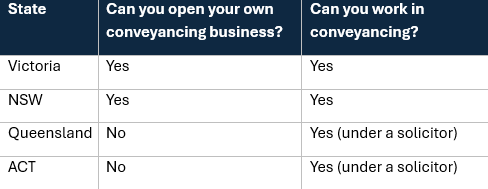
You can work in conveyancing — but you cannot operate as an independently licensed conveyancer in these states.
This often surprises people, because conveyancers can be licensed in Victoria and New South Wales. Australia does not have a single national licensing system for conveyancing — each state regulates property law differently. Understanding this properly is important before choosing your study pathway.
Why Queensland and the ACT are different
In Queensland (Qld) and the Australian Capital Territory (ACT), conveyancing is classified as legal work rather than a separate licensed profession.
This means only an Australian legal practitioner (ie. a solicitor) may provide conveyancing services directly to the public. However, and this is the key point, the solicitor does not
usually do all the work personally.
Instead, most of the day-to-day conveyancing tasks are performed by trained staff working under the solicitor’s supervision.
Can you still work as a conveyancer?
Yes.
Many people work in conveyancing roles in Queensland and the ACT without being lawyers.
Common job titles include:
- Conveyancing Assistant
- Conveyancing Officer
- Property Law Clerk
- Conveyancing Paralegal
- Settlements Officer
In many law firms, the trained conveyancing staff manage files from start to finish, while the supervising solicitor reviews and signs off on legal responsibility.
So while you cannot run your own independent conveyancing practice, you can absolutely build a long-term career in the profession.
What work do conveyancing staff actually do?
Conveyancing employees typically handle:
- preparing and reviewing contracts
- ordering property searches
- liaising with banks and real estate agents
- calculating settlement adjustments
- preparing transfer documents
- organising electronic settlement
- communicating with buyers and sellers
- managing deadlines
Modern conveyancing also includes electronic settlements using platforms such as PEXA and digital identity verification.
Queensland conveyancing rules
In Queensland, conveyancing services are regulated under the legal profession framework. Only solicitors may offer conveyancing services to the public as a business. This means:
- you cannot open your own conveyancing company
- you cannot charge clients independently
- you must work within a law practice
However, law firms actively employ trained conveyancing staff because solicitors rely on them to manage transactions efficiently.
For this reason, employers commonly prefer applicants who hold a recognised conveyancing qualification and understand settlement procedures.
ACT conveyancing rules
The ACT operates under a similar model. Conveyancing is considered a legal service and is supervised by legal practitioners. Only a solicitor may formally provide the service to clients, but non-lawyers perform much of the practical work.
Most Canberra law firms have dedicated conveyancing teams consisting of paralegals or conveyancing officers who manage settlements and client communication.
Do you still need a conveyancing qualification?
While there is no licence application in Queensland or the ACT, employers still expect proper training. Law firms generally look for people who already understand:
- contracts of sale
- settlement procedures
- title searches
- deadlines and adjustments
- electronic settlement systems (PEXA)
- client communication
This is why the Advanced Diploma of Conveyancing is still widely valued in these states — it functions as industry training rather than a licence pathway.
Typical career progression
A common pathway in Queensland and the ACT looks like:
Conveyancing Assistant
→ Conveyancing Officer
→ Senior Conveyancer / Paralegal
→ Practice Manager
Many professionals remain in these roles long-term and do not need to become solicitors. Some actually prefer this pathway because it avoids professional indemnity risk, trust account management and business compliance obligations.
Does the qualification still lead to employment?
Yes. The qualification prepares you for employment within a legal practice rather than immediate independent licensing.
In fact, some students specifically choose this pathway because they want:
- stable employment
- a professional office role
- no responsibility for operating a business
What if you later want to run your own practice?
Many people begin their careers working in law firms to gain experience. Later, some relocate to a state such as Victoria or New South Wales where independent conveyancer licensing is available and then apply for a licence using their qualification and experience.
Final thoughts
Conveyancing remains a viable career in every Australian state. The only difference is how it is regulated.
In Victoria and NSW you may operate your own conveyancing business.
In Queensland and the ACT you work within a legal practice under a supervising solicitor.
Either way, the day-to-day work, managing property transactions and helping clients through settlement — is very similar.
Not sure if this career suits you?
Read: Is Conveyancing a Good Career in Australia?
Still deciding on a pathway?
Visit our Career Pathways Guide or speak with a Course Advisor to discuss your goals.